

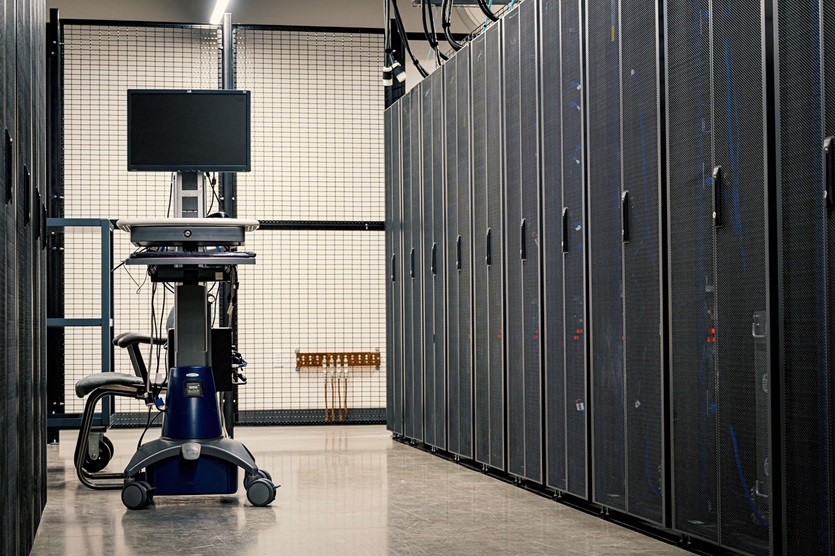
Rear door heat exchangers provide efficient cooling for high-density data centres. They attach directly to server racks and remove heat from exhaust air.
Unlike traditional room cooling, these systems target heat where it originates. As a result, they can improve cooling efficiency and reduce energy consumption.
What Is a Rear Door Heat Exchanger?
A rear door heat exchanger replaces or attaches to a server rack’s rear door. It contains a water-cooled coil that absorbs heat from server exhaust air.
Servers draw cool air through their front panels during operation. Meanwhile, they release heated air through the rear.
The rear door exchanger captures this hot exhaust air. Consequently, it prevents excessive heat from entering the data centre environment.
How Does a Rear Door Heat Exchanger Work?
The cooling process begins when servers produce heat during normal operation. Their fans then push warm air towards the rack’s rear.
Next, the heated air passes through the exchanger’s cooling coil. Chilled water flows through the coil at the same time.
The water absorbs heat from the passing air. Therefore, the air leaving the exchanger becomes significantly cooler.
Finally, the cooled air returns to the data centre. The process continues continuously while the servers operate.
What Components Does the System Use?
A typical rear door heat exchanger contains several important components. Each component contributes to effective rack-level cooling.
The main component is the cooling coil. It transfers heat between the hot server exhaust and chilled water.
The system also includes fans or uses existing server fans. Additionally, water connections supply and remove chilled water from the coil.
Control systems can regulate water flow and monitor temperatures. Sensors may also detect leaks, airflow conditions, and system performance.
Why Do Data Centres Use Rear Door Heat Exchangers?
Modern servers generate substantial heat, especially in high-density computing environments. Therefore, conventional cooling systems can struggle with concentrated heat loads.
Rear door heat exchangers provide targeted cooling directly at the rack. This approach reduces the amount of heat released into the room.
Furthermore, they can support higher rack densities without major room modifications. Data centres can therefore accommodate powerful computing equipment more efficiently.
They also help reduce hot spots around server racks. Consequently, they can contribute to more stable operating temperatures.
How Does Water Remove Server Heat?
Water transfers heat efficiently because it has high heat capacity. The chilled water enters the exchanger at a controlled temperature.
As hot air crosses the coil, heat moves into the water. The warmed water then travels away from the exchanger.
Afterward, a cooling system removes that captured heat. The cooled water can then return to the heat exchanger.
This continuous cycle allows the exchanger to manage substantial heat loads. However, proper water temperature and flow remain essential.
What Are the Benefits of Rear Door Heat Exchangers?
Rear door heat exchangers offer several benefits for modern data centres. Most importantly, they provide cooling directly where server heat concentrates.
They can also support high-density server deployments. Additionally, they reduce the cooling burden placed on room-level systems.
Another advantage involves space efficiency. Because the exchanger attaches to the rack, it requires limited additional floor space.
Moreover, these systems can operate alongside existing cooling infrastructure. Therefore, facilities can improve rack cooling without completely redesigning their cooling architecture.
Are Rear Door Heat Exchangers Suitable for Every Rack?
Not every server rack requires a rear door heat exchanger. Low-density environments may already have sufficient room-level cooling.
However, high-density racks often benefit significantly from targeted cooling. Applications involving artificial intelligence and high-performance computing can generate considerable heat.
Rack compatibility also matters. The exchanger must match the rack size, server configuration, airflow pattern, and cooling infrastructure.
Therefore, facility operators should evaluate heat loads before selecting a system.
What Maintenance Does a Rear Door Heat Exchanger Need?
Regular maintenance helps maintain reliable cooling performance. Technicians should inspect coils, connections, valves, sensors, and drainage systems.
They should also check for leaks and unusual temperature changes. Furthermore, keeping the coil clean helps maintain effective heat transfer.
Water quality requires attention as well. Poor water quality can contribute to corrosion, scaling, or reduced performance.
Routine inspections can therefore prevent avoidable cooling problems. In addition, monitoring systems can provide early warnings when conditions change.
Conclusion
Rear door heat exchangers remove server heat directly from rack exhaust air. They use chilled water to transfer heat away from high-density equipment.
As a result, they provide targeted and space-efficient cooling. Furthermore, they can support demanding computing environments and reduce room cooling requirements.
For high-density data centres, this technology offers a practical approach to managing increasing server heat loads.
Leave A Comment