

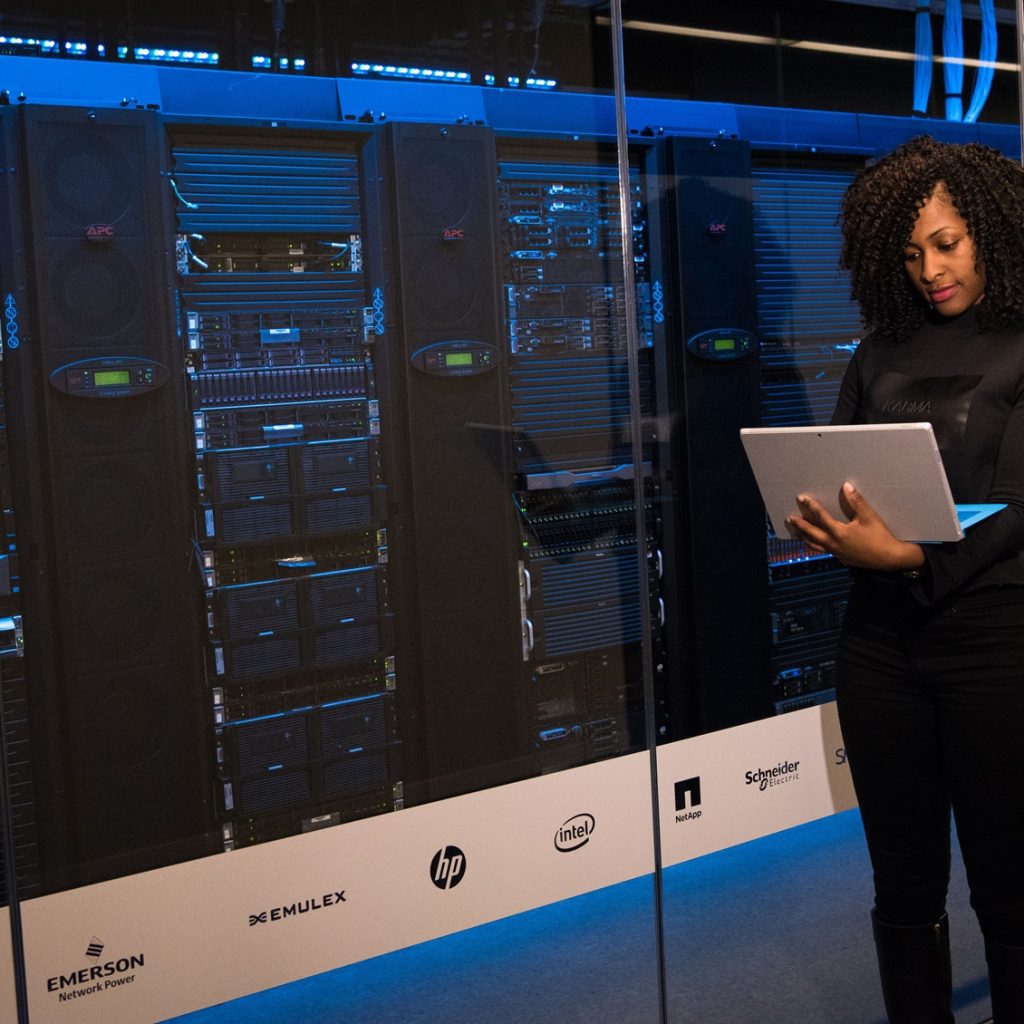
Data centres generate significant heat as computing systems operate continuously. Therefore, effective cooling remains essential for maintaining reliable performance and equipment lifespan.
Two modern cooling approaches are rear door cooling and direct-to-chip cooling. Both support high-density computing environments. However, they manage heat differently.
Understanding these differences helps data centre operators choose suitable cooling infrastructure.
What Is Rear Door Cooling?
Rear door cooling uses a specialised heat exchanger attached to the back of a server rack. Consequently, it captures hot exhaust air before that heat enters the room.
The system typically connects to a chilled-water or facility-water loop. Hot air passes through the rear-door coil and transfers heat into the water.
Afterward, the cooled air returns to the data centre environment. Meanwhile, the heated water travels through the cooling system for heat rejection.
This approach works well with conventional air-cooled servers. Additionally, it can support higher rack densities without completely redesigning existing infrastructure.
What Is Direct-to-Chip Cooling?
Direct-to-chip cooling transfers heat directly from processors and other high-power components. Instead of cooling hot room air, it targets the heat source itself.
A cold plate sits directly against the processor or accelerator. Coolant flows through the plate and absorbs heat from the component.
The heated coolant then moves toward a heat-rejection system. As a result, significantly less heat enters the surrounding data centre air.
Direct-to-chip cooling is increasingly relevant for artificial intelligence and high-performance computing. These workloads can produce much higher thermal loads than traditional servers.
Rear Door Cooling vs Direct-to-Chip Cooling
The biggest difference involves where heat gets captured.
Rear door cooling captures heat after it leaves the server. Direct-to-chip cooling captures heat directly from critical components.
Therefore, direct-to-chip systems can remove heat earlier in the thermal process. Rear door systems, meanwhile, remain closer to conventional air-cooling designs.
However, both approaches can reduce cooling challenges in high-density environments.
How Do Their Cooling Methods Compare?
Rear door cooling relies primarily on airflow through a heat exchanger. Server fans push hot exhaust air through the rear door.
Direct-to-chip cooling instead uses liquid flowing through cold plates. This creates a more direct path between the heat source and cooling medium.
Consequently, direct-to-chip systems can handle extremely concentrated component-level heat loads.
Rear door cooling can still provide substantial cooling capacity. Furthermore, it often requires fewer changes to standard server configurations.
Which Technology Supports Higher-Density Servers?
Direct-to-chip cooling generally suits extremely high-density computing applications. AI accelerators, GPUs and specialised processors can generate substantial heat.
However, rack density varies considerably between deployments. Therefore, cooling requirements should depend on actual equipment specifications.
Rear door cooling can support increased rack densities compared with traditional room-based cooling. Nevertheless, very high-density systems may require liquid cooling at the component level.
In some environments, operators can also combine cooling technologies. For example, direct-to-chip cooling can handle processor heat while air cooling manages remaining components.
Installation and Infrastructure Requirements
Rear door cooling can integrate with existing server racks and airflow designs. Consequently, deployment may involve fewer hardware changes.
However, operators still need suitable water connections, pumps and control systems. Rack weight and door clearance also require careful consideration.
Direct-to-chip cooling usually requires compatible servers or specialised conversion kits. Additionally, coolant distribution infrastructure becomes more important.
Operators must consider manifolds, hoses, cold plates and leak-management systems. Therefore, planning requirements can become more complex.
Energy Efficiency Considerations
Both technologies can improve cooling efficiency when properly designed. However, actual results depend on facility architecture and operating conditions.
Rear door cooling reduces the amount of heat released into the data centre space. Therefore, room-level cooling systems may operate more efficiently.
Direct-to-chip cooling can remove heat directly from processors. Consequently, it can reduce dependence on large volumes of conditioned room air.
Moreover, some liquid-cooling systems can operate with higher coolant temperatures. This may create additional opportunities for efficient heat rejection.
Maintenance and Reliability
Rear door systems require maintenance of coils, filters and water circuits. However, their design can remain relatively familiar to data centre technicians.
Direct-to-chip systems introduce additional liquid-cooling components. Therefore, maintenance procedures must address coolant quality and connection integrity.
Leak detection also becomes particularly important. Nevertheless, modern liquid-cooling systems can incorporate monitoring and protection mechanisms.
Which Cooling Approach Should You Choose?
The right choice depends on workload density, server design and facility infrastructure.
Rear door cooling can suit organisations upgrading conventional air-cooled environments. It provides additional cooling capacity without necessarily replacing every server.
Direct-to-chip cooling can suit facilities supporting demanding AI and high-performance computing workloads. It provides targeted thermal management for high-power components.
Ultimately, operators should evaluate heat loads, rack density, infrastructure costs and future expansion plans.
Final Thoughts
Rear door cooling and direct-to-chip cooling solve similar problems differently. Rear door systems capture hot exhaust air at the rack level.
Direct-to-chip systems remove heat directly from processors and other high-power components. Therefore, each technology serves different deployment requirements.
As computing densities increase, liquid cooling will become increasingly important. Choosing the right approach requires careful consideration of current and future workloads.
Leave A Comment